Explore AI-assisted payment follow-up: review contact eligibility, prepare approved options and record next steps, with hardship and disputes handled by your team.
An eligible payment follow-up is due under the agreed contact rules.
AI agents
Outreach worker
Verification worker
Resolution worker
Human decisions
Hardship & disputes specialist
Collections supervisor
Workflow steps
1
Select & checkCollections supervisor
2
ReachOutreach worker
3
VerifyVerification worker
4
Understand intentResolution worker
5
Resolve or escalateResolution worker
6
Write backResolution worker
4 operating rules · 4 decision rules · 4 channels · records to verify
Illustrative design. Systems, permissions, human coverage and outcomes must be configured and validated for your deployment.
THE RESULT TO CHECK
A recorded response and approved next step, with hardship, disputes and exceptions referred to specialists.
On this page
Inside Voxistry /Team Canvas
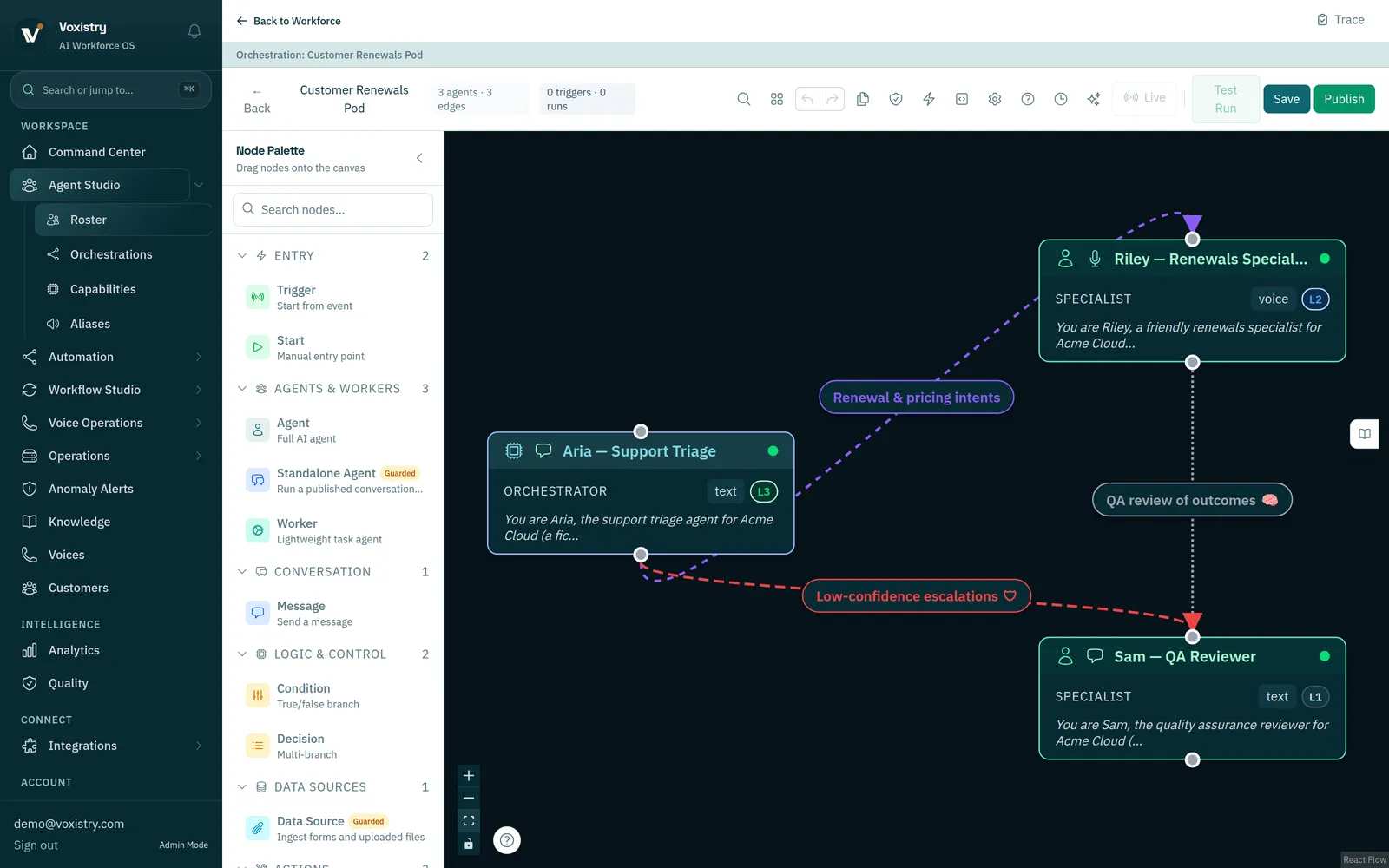
Team Canvas · July 2026 demo workspace · Fictional subscription-renewal team showing roles and delegation. Review the collections workflow and its payment records separately in your demo.Expand to inspect the full capture.Specialist roles and delegation · Close-up. Expand for the full workspace.
The operating problem
A customer has discussed an overdue balance, but the agreed next step is missing from the account record and another team calls again. This example helps a collections team prepare permitted follow-up, use approved payment options and check that the resulting record was accepted by the account system. Start with one segment and staff review. A promise to pay is separate from a confirmed payment; hardship, disputes and exceptions stay with responsible people.
Repeated attempts and identity checks can leave staff less time for accounts that need a detailed conversation.
Contact permissions, restrictions and recent attempts may be spread across systems, making eligibility difficult to check before follow-up.
A delayed or failed account update can leave another team working from an outdated promise, dispute or contact preference.
Who handles the work
Example division of work between AI workers and your team.
AI worker
Outreach worker
Prepares follow-up on a selected channel using available contact permissions, restrictions and recent-attempt information.
Contact attempt and consent state
Within agreed contact rules; uncertain eligibility stays with staff
AI worker
Verification worker
Supports the agreed identity check before account discussion, leaving uncertain or failed checks with staff.
Identity confidence threshold
Within agreed identity requirements; disclosure controls need testing
AI worker
Resolution worker
Uses current approved account information to discuss permitted options and prepare the proposed next-step record.
Offers inside the approved matrix
Acts with approval — anything outside the plan matrix needs a supervisor
Human owner
Hardship & disputes specialist
Reviews hardship, vulnerability and disputed-balance requests with the available account and conversation context; accepts responsibility for specialist follow-up.
Forbearance and dispute decisions
Full authority
Human owner
Collections supervisor
Reviews scored conversations, approves exceptions, and tunes the policy boundaries.
Approval thresholds and quality standard
Full authority
How the work could flow
Use this sequence to agree the workflow and test each step before launch.
01Collections supervisor
Select & check
Is this account eligible to contact right now under consent, DNC, and frequency rules?
02Outreach worker
Reach
Which channel and time has this customer actually responded to before?
03Verification worker
Verify
Is identity confidence high enough to discuss the account at all?
04Resolution worker
Understand intent
Pay now, arrange a plan, dispute the balance, or declare hardship?
05Resolution worker
Resolve or escalate
Is the requested arrangement inside the approved matrix, or does it need a person?
06Resolution worker
Write back
Did the intended arrangement, dispute or contact-preference record save successfully, and who follows up if it did not?
Decisions your team keeps
Proposed operating requirements to configure and verify, including what happens when a system or human handoff is unavailable.
Configure routine collection to stop when hardship or vulnerability is identified. Test recognition, specialist acceptance and the fallback when nobody is available.
Disputed balances are never argued: the worker records the dispute and hands it to a human handler.
Arrangements outside the configured plan matrix require supervisor approval before they are offered, not after.
Configure consent-revocation and do-not-contact handling for each selected channel. Verify that scheduled attempts are suppressed and that failed updates reach an accountable owner before enabling outreach.
Test current consent, do-not-contact restrictions and recent attempts before enabling each outreach pathway.
Test disclosure restrictions for failed, incomplete and uncertain identity checks before account discussion is enabled.
Approved script and offer boundaries, with supervisor approval required to exceed them.
Review available records of contact attempts, disclosures, offers and escalations against the required evidence.
Systems & channels
Systems to connect
Scope these around the selected implementation.
Collections & loan servicing platform
CRM
Payment gateway
ViciDial or Twilio telephony
Channels to evaluate
Select and validate the required provider pathways.
Voice
SMS
WhatsApp
Email
What to measure
Pilot measurement definitions, not claimed customer results.
Instrumented per attempt
Contact-to-resolution
Compare attempts and reached customers with accepted arrangements and confirmed payment outcomes. Keep unresolved contacts and missing payment records visible.
Agreed vs kept
Promise integrity
Compare agreed terms with the record accepted by the account system, then check payment records before counting an arrangement as kept. Track failed and corrected updates.
Audit coverage
Evidence coverage
Review available records of contact checks, identity outcomes, offers and specialist requests. Identify missing events and test integrity, export and reviewer access against the agreed requirements.
A bounded rollout
01Stage 1
One portfolio segment, suggest-only
Choose one account segment with approved contact rules and payment options. Workers prepare follow-up and next steps; staff review the proposed actions and available records to establish a baseline.
02Stage 2
Act within the approved matrix
Test the selected contact and identity checks, approved options and account updates. Include uncertain eligibility, rejected writes and an unavailable specialist before deciding which actions workers may take.
03Stage 3
Widen the portfolio
Review duplicate or restricted attempts, failed updates, accepted specialist requests and payment outcomes before adding a segment or channel. Confirm the permissions and human coverage for each expansion.